
Under Documents » Settings » Extra Fields you can manage extended information linked to a document. Extra Fields can be used as search criteria in Query Builder, added to a document header, and displayed alongside the document number.
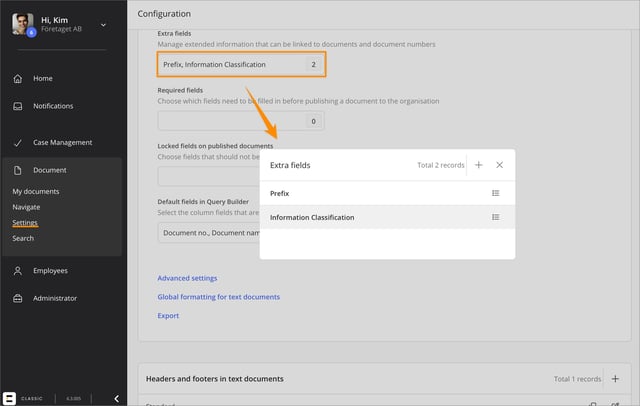
How to create and edit Extra Fields
-
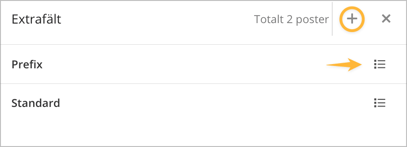 To create a new Extra Field, click +, enter a name, and select the field type. You can find more details about each field type in the sections below.
 - https://helpdesk.amsystem.com/en/bulk
-
If you select the Value list or Name list field type, you then need to add the values that should be available. Do this by clicking the icon to the left of the Extra Field name. When adding values, you can either use the plus icon to create individual entries or use the Add multiple values function to quickly type or paste several values at once.
Rename or delete an Extra Field
-
To rename an Extra Field, click directly on its name, enter the new name, and confirm. Choose a name that clearly describes the type of information to be stored in the field, such as “Site,” “Line,” or “Information classification”, so it is easy for users to enter the correct data when publishing.
In the same place, you can also choose to delete the Extra Field entirely. Before doing so, it is wise to confirm that the field is no longer used in ongoing workflows, reports, or searches in Query Builder. Keep in mind that if you delete an Extra Field, all information stored in that field is removed from every document where it is used, including both published documents and drafts.
Edit values in value lists
- To adjust the contents of a value list, click the icon to the left of the Extra Field name. This opens an overview of all existing values. Here, you can delete a value (trash can icon) or edit a value (pencil icon). You can also choose to deactivate a value instead of deleting it. A deactivated value remains visible in older documents where it has been used but can no longer be selected in new documents – a convenient way to clean up without losing history. Note that the option to deactivate values is only available for the **Value list** field type.
Edit values in name lists
- To update the contents of a name list, click the icon to the left of the Extra Field name. A list of all existing names will open, where you can add new entries or remove names that should no longer be available.
Extra Fields – available field types:
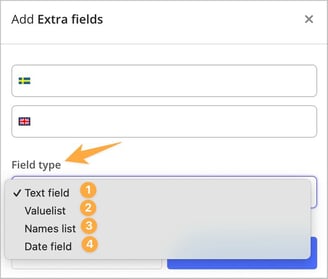 Text field. With the Text field type, the person publishing the document can enter any free text. Note that the system does not limit the number of characters, which may, for example, affect how a header is displayed.
- Valuelist. With the Valuelist field type, you define the options that can be selected in the Extra Field. Each option represents a predefined value, for example a document type, department, or classification.
When you create a value list, you can choose whether the user should only be able to select a single option, or be allowed to select multiple options. If you already have a single‑select value list, it can be converted to multi‑select, provided it is not used as part of the document number. Note that a multi‑select list cannot be converted back to single‑select!
A multi‑select Extra Field can, for example, be used to indicate where a document is printed, such as in production, the warehouse, the workshop, or reception. When the document is revised, it then becomes easy to see which printed copies need to be replaced, reducing the risk that older versions continue to be used in the organisation. - Names list. With the Names list field type, you define which individuals can be linked to the document at the time of publication. The list can only include users who have access to the Documents module. When this Extra Field is used, exactly one person must be selected – multiple selections at the same time are not possible.
- Date field. With the Date field type, the person publishing the document can tag it with a specific date.
How to use Extra Fields
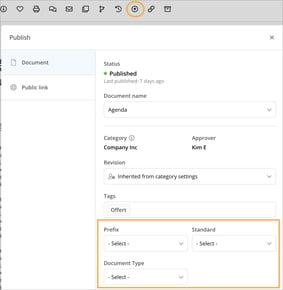 By applying Extra Fields when you publish a document, you can add flexible, structured information that enriches the document’s metadata and makes it easier to search, filter, and organise. This might include details such as site, line, product, process owner, classification, or period of validity – information that is often needed for follow‑up, audits, or investigations.
This ensures that critical information always follows the document and remains easy to find and manage later on, regardless of who is searching or where in the organisation they are. Extra Fields also enable more precise, targeted searches in Query Builder.
You can also define an Extra Field as a required field, ensuring it must be completed before a document can be published. This reduces the risk of incomplete documentation, supports compliance with relevant standards, and helps guarantee that reports and follow‑ups are based on complete and comparable information.
-
Use Extra Fields as part of the document number
Which Extra Fields can be included in the document number, and how they are displayed, is managed under Advanced Settings. Note that value lists that allow multiple selections cannot be used as part of the document number. -
Add Extra Fields to the header/footer
You can also include one or more Extra Fields in a document’s header to clarify key information, such as document classification. In text documents, this is configured via Documents » Settings » Header and Footer in Text Documents. -
Add Extra Fields to the header/footer
You can also place one or more Extra Fields in a document’s header or footer to clarify key information, such as document classification. In text documents, this is configured via Documents » Settings » Header and Footer in Text Documents. In layout documents, add the fields via the Insert Company and Document Information function in each layout document.
Note that information from Extra Fields that are not multi‑select is shown in the header as regular text, using the text colour and formatting you have configured. Extra Fields of the Valuelist type that allow multiple selections are always displayed with black text on a grey background.
💬 Note: Profiles with the permission Access to edit the document information on all published documents can add or modify content in Extra Fields even after a document has been published.
Search in Query Builder using Extra Fields
In both Standard and Advanced search in Query Builder, all created Extra Fields are available and can be used to build precise search queries. For example, you can filter documents by site, process owner, classification, validity period, or other values managed via Extra Fields. By combining several Extra Fields in the same search, you can quickly narrow down the results to exactly the documents you need, which simplifies everything from ongoing follow‑up to preparation for internal and external audits.
It is also useful to know that Extra Fields can be included as Standard fields in Query Builder or as Search results fields in the search results. This lets you immediately see which information is populated in each Extra Field directly in the result list, without opening the document.
Standard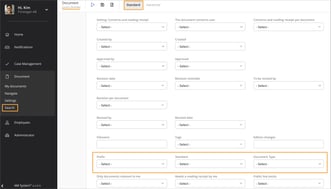 |
Avancerad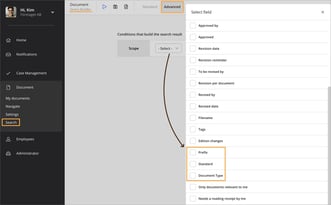 |
Related content:
- Required Fields for published documents
- Locked Fields on Published Documents
- Where to create Header/Footer in a text document
- How to Create a Header in Text and Layout Documents
- Advanced Settings
- Search Functions in Documents
- How to Create a Header in Text and Layout Documents
- Adding multiple values to lists