
Classic supports multiple languages and comes with Swedish and English as standard. If you need additional languages, they can also be ordered.
If you do not see the option to translate fields into multiple languages in the form editor, or if language settings are missing from the form, the most likely reason is that only one language is activated in your system. For more information about how languages are managed in the system, see the article Manage languages in AM System.
Language settings in forms
💬 When a user works with a case in Classic, the system automatically detects the user’s preferred language from their profile settings and displays the form in that language, provided that the language is activated in the form. If the user’s language is not activated in the form, the form will instead be shown in the default language set for that form.
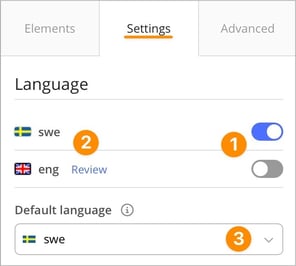 Each form has its own language settings that affect that specific form. You can find these settings under the Settings tab, where you can activate or deactivate languages, review how the form looks in a specific language, and set a Default Language.
- You can activate or deactivate languages that you do not intend to use in the current form. Please note that you cannot deactivate a language that is set as the default language.
- You can preview the form in each language. This only affects how the form appears while editing and is a useful way to make sure you have not missed translating any field.
- The Default language setting determines which language the form is shown in during public registration. Because the user is not logged in when using public registration, the system cannot read that person’s profile settings and will instead display the form in its predefined default language.
When a user is logged in, the form is normally shown in the language selected in the user’s profile. However, if that language is deactivated in the form, the form’s default language will be shown instead.
Translate titles and list options
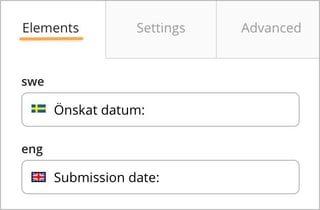
Multilingual support does not only mean that the system itself can be used in multiple languages, but also that you can create forms with content in multiple languages. You do this by adding and translating field titles for each language in which the form should be available.
To add or update a field title, select the relevant field and then go to the Elements tab. There, you can enter the title for each language that is activated in the form, according to the instructions above.
Keep in mind that translating the field titles alone is not enough. If the form contains the field types List, Checklist, and Radiolist, all options in those fields must also be added and translated into the languages you want to use. If an option is missing a translation in one language, the form may appear incomplete or unclear to the user.
To make sure the form is fully translated, we therefore recommend reviewing both field titles and field options in all relevant language versions before the form is put into use. This is easiest to do with the review function mentioned above.