Introduction
The purpose of this feature is to provide a simple way to link to and reference published documents from other services, such as an intranet or via email. Instead of instructing the user to "Go to the AM System and search for Document #1083," you can now provide a link that takes the user directly to the specified document.
Note: The feature Link to this document should not be mistaken with the Public link function, which allows a document to be shared with a recipient who does not have a user account in the system.
Permalinks require that the recipient has a user account in the AM System and that the user has the necessary permissions to view the specific document. If the user is logged in when they click the link, they will be taken directly to the document. If the user is not logged in, they will be prompted to log in to gain access to the document. Should the user lack the appropriate permissions for the linked document, an error message will be displayed stating, "You do not have permission to see this document"
How to Copy a Link
To copy a link to a published document, first navigate to the document you wish to link to. Then, click on the link icon located in the document menu.
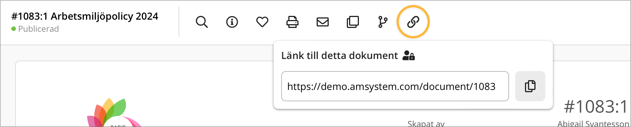
Afterwards, you can use the icon to the right of the link for easy copying (or select the link and choose "Copy" via your web browser). Finally, you can paste the link into the service or function you wish to use.
💬 Tip: Every published document has a permalink, even before a user clicks the link icon in the document menu. This means the link exists and works as soon as the document is published, regardless of whether anyone has opened the link dialog. The copy function simply makes it quicker and easier to find, verify, and copy the link, for example when you want to paste it into an intranet page, an email, or another external service.
You are not dependent on the copy function to use permalinks. Because the link always follows the same logical structure, you can enter it manually whenever needed – for example in a work instruction, training material, or an external system where you do not have direct access to AM System. All you need to know is the web address (domain) of your AM System environment and the document number of the published document. With these two pieces of information, you can construct the permalink yourself without first navigating to the document.
The permalink always begins with the address of your site, for example:
https://company.amsystem.com
After that, add /document/ (note the forward slashes before and after the word, and that “document” is always written in English with a C), and finally append the document number without any extra characters or spaces. The general structure is:
https://[your-domain.amsystem.com]/document/[document-number]
For example, if your document “Nonconformity Management” has the number 2050 and your environment is available at https://quality.amsystem.com, the permalink will be:
https://quality.amsystem.com/document/2050
Keep in Mind...
- All users who have access to a published document can also copy the link to that document. However, the recipient must be logged into the system and have access to the document in order to read it.
- Every time a user clicks on a permalink that leads to the AM System, a new tab or window will open with the specified document. This could result in the user having multiple tabs or windows open with the AM System at the same time. Therefore, avoid creating a "link library." Instead, consider linking to a "home page," where you can gather the remaining links. This approach allows for easy maintenance of the home page, from which further documents or functions in the AM System can be linked.
- It is not possible to create permalinks to drafts or templates, only to published documents.