
Background
The field types Number and Calculation do not have units linked to them by default and display information in fields as integers. Using the Units function, you can add units to specify and convert information, as well as influence how information is displayed in fields linked to the respective unit group.
Common examples of using Units include volume, weight, length, time, or currency. Essentially, wherever there is a need to convert between units.
- Only Administrators have the ability to manage Units. The function is located under Case Management » Settings » Units.
- Administrators and users with permission to edit forms can then link unit groups to the field types Number and Calculation fields. Read more about this below.
❗ Note: We strongly recommend that you do not change the unit group on a field that already contains registered data, as previously saved values cannot be automatically converted to the new group. See the full explanation later in this article.
Add Unit Group
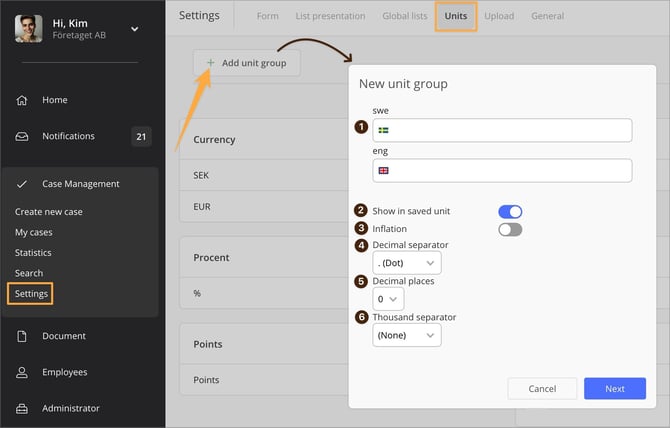
Start by creating the foundation for your unit using the Add Unit Group function. The settings you can configure are:
1. Name:
Choose a name that reflects what the unit will manage to make it easier when linking units to numeric fields in your forms.2. Show in Saved Unit:
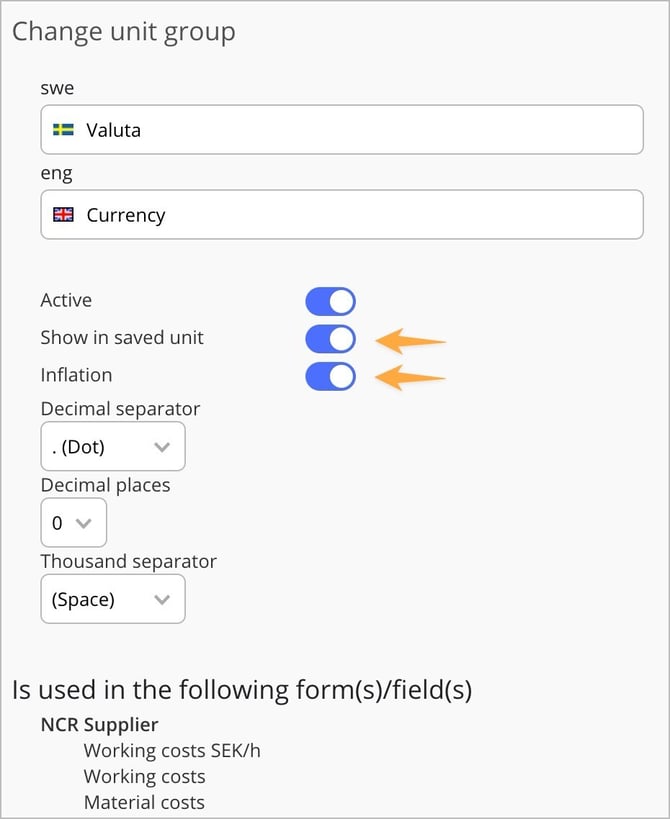
The Show in saved unit setting controls which unit is displayed when a case is reviewed.If the function is enabled, the value is shown in the unit that was selected when the case was last saved. For example, if the field was saved in USD, the value will be displayed in USD during review.
If the function is disabled, the value is always displayed in the field’s base unit when the case is reviewed, regardless of which unit was used when the case was last saved.
It is also important to note that no conversion between units takes place while the case is being edited. For example, if a value is 10 USD and the user wants to change it to 100 SEK, the user must manually enter 100 and then select SEK. Automatic conversion between units is only performed in review mode, not in edit mode.
3. Inflation:
Used for currency management. Allows adjustments to exchange rates without affecting already registered cases.4. Decimal Separator:
Choose between a dot (0.0) or a comma (0,0).5. Decimal places:
Select whether the unit should display 0-3 decimal places.6. Thousand Separator:
Choose how the unit will display thousands: None, Dot (1.000), Comma (1,000), or Space (1 000).
Manage Unit Group
Base Unit
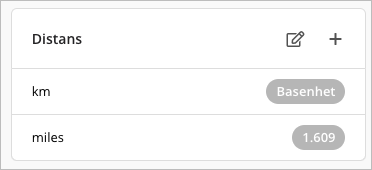
The first unit you add to a new unit group is saved as the Base Unit and has the value of 1.
The base Uunit forms the foundation of the unit group and is the value used for conversions when adding additional units to the group. Note that the base unit appears in lists and summaries, making it the default unit. During case review, the value is displayed in the base currency unless the Show in saved unit function has been activated for the unit. More information on this is provided below.
|
Edit Unit Group
|
.gif?width=670&height=839&name=units(gif).gif) |
💬 Tip: Display decimals in the Number field type using a Unit Group. A number field in a case will always display as whole numbers if no unit group is assigned to the field.
- If you need to show the exact input during review when using the Number field, you can create a Unit Group containing only the Base Unit with the setting to display decimals. This Unit Group can then be linked to the number field. Registered values will then display with decimals instead of only whole numbers.
💬 A Few Examples
|
Distance |
|
|
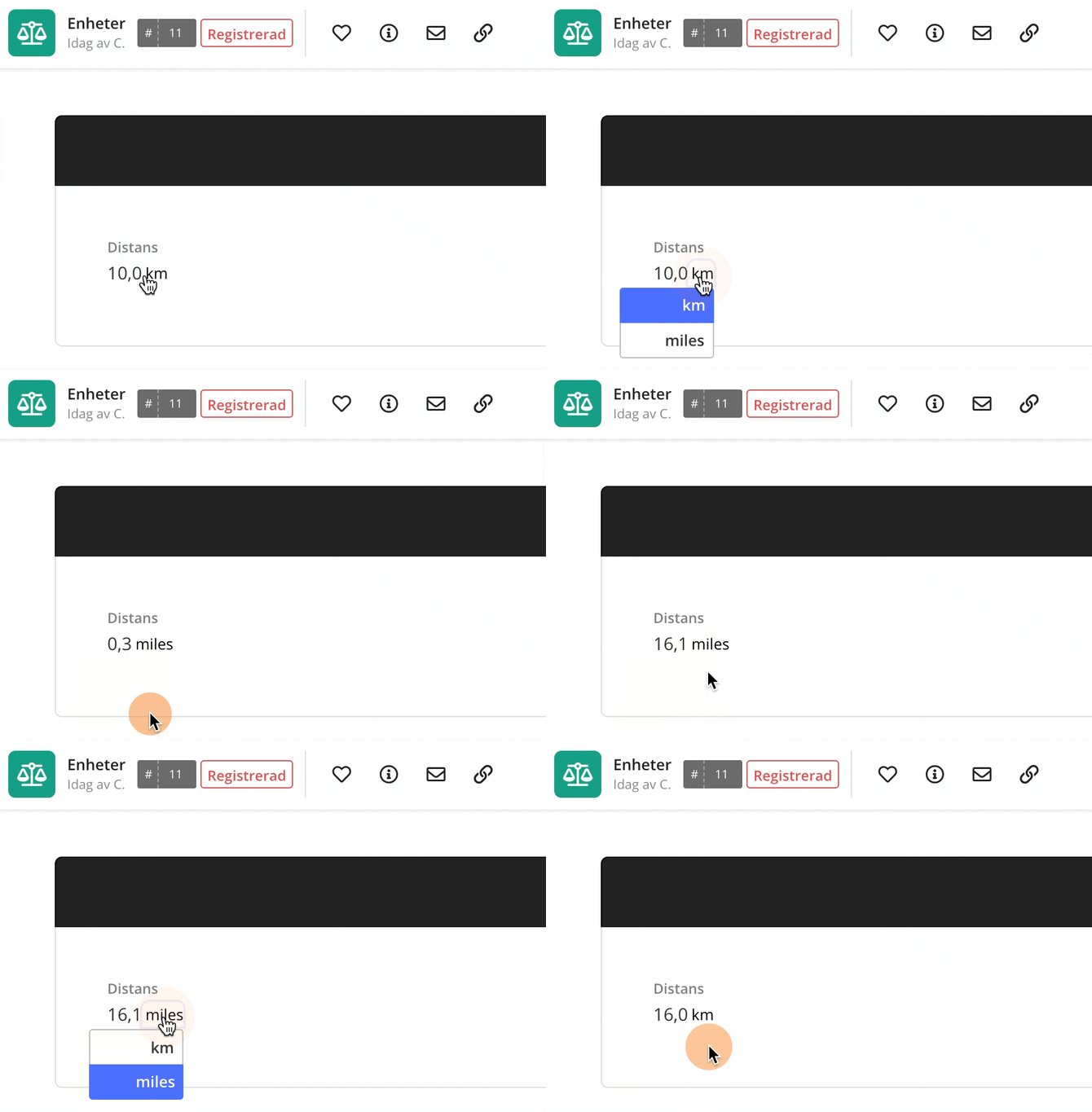
When a case has been registered, the reader can convert the number of kilometers to miles and vice versa within the registered case. |
 |
|
Currency Show in saved unit Inflation |
 |
Link Unit Groups to Number or Calculation Fields
Once your units have been created, they need to be linked to the fields where you want to use the corresponding unit.
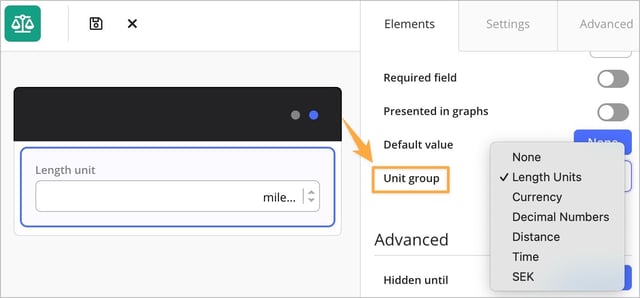
Unit groups can only be linked to the field types Number and Calculation. To link a unit: Navigate to the form (Case » Settings). In the form, select the field you want to assign a unit to and choose the appropriate unit group from the list. Don’t forget to save the form.
❗ Note: We strongly recommend that you do not change the unit group on a field in a form that already contains registered data. The reason is that the unit used in the field is saved together with the value in each individual case. If the unit group is changed afterward, previously saved cases may no longer be handled in a safe or predictable way, because the system cannot automatically interpret or convert earlier values to the new unit group.
This becomes especially clear when switching between two completely different types of units. For example, if a field was previously linked to the unit group Weight with units such as hectograms, kilograms, and tons, and is then changed to the unit group Distance with units such as meters, kilometers, and miles, the system has no way of determining how the existing values should be interpreted. As a result, previously registered values may become misleading or incorrect.
It is also important to understand that issues can arise even if the new unit group appears to be similar to the old one. Even if the units have the same names, for example if you create a new unit group with the same types of units as the previous one, the system still treats them as different unit groups. In that case, the system cannot determine how previously saved units should be translated or remapped, because the original link is tied to the unit group that was used when the case was saved.
If you need to make a major change to the unit logic of a field, the safest approach is to first review which forms and fields use the unit group and whether any existing registered data will be affected. In many cases, it is better to create a new field with the correct unit group from the start rather than changing an existing field that is already being used in active cases.
Also note that the system currently does not display a warning when a unit group is changed. This means the change can be made without alerting the user to the potential consequences for existing data. For that reason, such changes should always be made with extra caution.
❗Observera: Vi rekommenderar starkt att ni inte byter enhetsgrupp på fält i formuläret som redan innehåller registrerad data. Orsaken är att den enhet som används i fältet sparas tillsammans med värdet i varje enskilt ärende. Om enhetsgruppen därefter ändras påverkar det inte redan sparade ärenden på ett säkert eller förutsägbart sätt, eftersom systemet inte kan tolka om tidigare registrerade värden automatiskt till den nya enhetsgruppen.
Det här blir särskilt tydligt om man byter mellan två helt olika typer av enheter. Om ett fält till exempel tidigare varit kopplat till enhetsgruppen Vikt med enheter som hekto, kilo och ton, och sedan byts till enhetsgruppen Avstånd med enheter som meter, kilometer och mil, saknar systemet möjlighet att avgöra hur de befintliga värdena ska tolkas. Ett tidigare registrerat värde riskerar därför att bli missvisande eller direkt felaktigt.
Det är också viktigt att känna till att problem kan uppstå även om den nya enhetsgruppen vid första anblick verkar likadan som den gamla. Även om enheterna har samma namn, exempelvis om ni skapar en ny enhetsgrupp med samma typ av enheter som i den tidigare gruppen, betraktas dessa fortfarande som olika enhetsgrupper av systemet. Systemet vet då inte hur tidigare sparade enheter ska översättas eller kopplas om, eftersom kopplingen finns till den ursprungliga enhetsgruppen som användes när ärendet sparades.
Om ni behöver göra en större förändring av enhetslogiken i ett fält är det därför säkrast att först utreda vilka formulär och fält som använder enhetsgruppen samt om det redan finns registrerad data som påverkas. I många fall är det bättre att skapa ett nytt fält med rätt enhetsgrupp från början än att ändra ett befintligt fält som redan används i skarpa ärenden.
Tänk också på att ingen varning visas i systemet idag när en enhetsgrupp byts. Det innebär att ändringen kan genomföras utan att användaren uppmärksammas på vilka konsekvenser den kan få för befintlig data. Därför bör sådana ändringar alltid göras med extra försiktighet.