
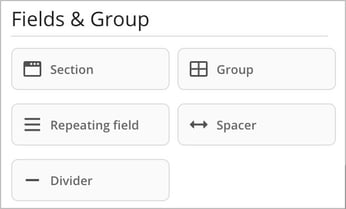
 Section
A form can consist of one or multiple sections, with each section represented by a blue dot in its black header. A form can consist of one or several sections, and the total number of sections is represented by a blue dot in each section’s black header. Sections are used to divide the form into multiple parts, where the user can only edit one part at a time. For example, a form can include a registration section, an action section, and a section for follow-up and closure.
Move sections
You can change the order of sections in a form by dragging and dropping them into the desired position. However, think through the change before moving sections in an existing form. Certain functions and settings may be built around the form’s current flow and the order of its sections, which means that changing the order can affect how the form works.
If you want to create a new section that should appear first in the form, there are a few special considerations to keep in mind. Read more here: Why can’t I create a new section at the top of a form?
Tip: A good rule of thumb is to create a new section for each department or individual responsible for handling the case.
Group
The Group field type allows you to visually group related fields within your form, making it easier to understand specific areas or fields that might later be restricted for certain users. The group field appears shaded to distinguish it from the standard white background.
Repeating Field
Use the Repeating Field when you need to enter recurring information multiple times within the same case. For instance, if several sub-actions need to be recorded in a single case, such as actions related to a deviation.
To create a repeating field, drag the Repeating Field type into your form. Within this field, add the desired field types it should contain.
Note: It is not possible to move fields that already exist in the form into a repeating field, or to move fields out of a repeating field.
If you want to use a repeating field, you must instead create new fields and drag them directly into the repeating field.
The reason is that the system must take existing data in already registered Cases into account. Therefore, fields cannot be moved in or out of repeating fields.
When registering a case, users will see the repeating field as a dashed rectangle labeled Add new. They can click Add new for each instance of information they wish to add.
Common uses include:
- Sub-actions related to deviations
- Assigning tasks in meeting minutes
- Recording items in complaints
Tip:
- Take advantage of the Done when function when working with repeating fields. This feature allows you to specify which particular fields within the repeating section must be completed for the entry to be considered finished—for example, when a sub-action is done. This makes it easy to get an instant overview of which sub-actions are completed in cases where multiple sub-actions are involved.
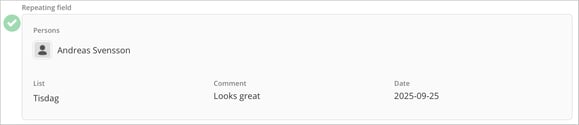
-
By default, repeating fields are sorted in the order in which they are created: the first entry appears at the top, followed by subsequent entries in chronological sequence. This gives the case handler a clear timeline of the recorded information, which is especially useful when following up on sub-actions or other events logged at different times.
In some workflows, however, it is more practical to immediately see the most recently added information, for example in cases where many recurring entries are added over a longer period. For this, the system provides the New posts first setting, which reverses the sort order and displays the most recently created entry at the top. When this setting is enabled, new information always appears first in the list of repeating entries, making it easier for the user to quickly see and continue working with the latest registration without scrolling.
- To make it clear to users that they are working with a repeating field, it is sometimes helpful to add an explanatory static text directly above the field. You do this by using the Heading or Text Field types. In this text, you can, for example, explain that the user needs to click “Add new” to display and fill in the fields within the repeating section.
Empty Space
The Empty Space field type serves as a visual separator, useful for aligning fields to the right or center within a form. In the form editor, it appears as a dashed line but displays as a blank area when users create a case.
Separator
The Separator field type is a visual divider used to separate different parts within a section of the form. It appears as a thin line and can span one, two, or three column widths, like other field types.